One of the biggest shifts brought about by new digital business models is that they have been built to meet needs that, in many cases, users did not even realize they had. Being able to put ourselves in the customer’s shoes and get inside their head to try to understand how they think, what they feel, or how they are influenced by the environment around them helps us identify those needs and develop our projects around one core principle: putting the user at the center and developing the product or service with them in mind.
Below, I’m going to show you one of the most widely used tools for carrying out this process: the empathy map. I’ll show you how to work through each phase, which questions you should ask yourself in order to shape each of the areas that make it up, and you’ll also see an example that will definitely be helpful.
On top of that, in my resources section you’ll find a fully editable template you can use to create your customer empathy map in a simple and efficient way. Let’s get started!
What Is an Empathy Map?
Within the first stage of designing a new business model—or even launching a new product or service within an existing company—there is one core principle: empathizing with our potential customer in order to better understand the way they think and behave.

That is exactly why the empathy map was developed: a tool that allows us to better understand our customer by identifying their problems and understanding how the value proposition we are going to offer will help solve them.
In order to properly define our customer segment, it is no longer enough to segment based only on age, location, tastes, or hobbies, among other things. We also need to deeply analyze the way they think, communicate, behave, and even how their environment influences all of those factors.
The best way to truly understand our customer is by putting ourselves in their place—that is, by empathizing with them. The empathy map was created precisely for this purpose by the company XPLANE, as a way to profile our customer and visually and efficiently figure out what they really need.
What Are the Advantages of an Empathy Map?
The empathy map allows us to gain deeper knowledge of the customer by identifying what they expect, what their goals and aspirations are, what their interests are, how they consume, and even which factors cause them discomfort and frustration. Once that analysis has been completed, we will be able to group together customers who share similar characteristics and create tailored actions or solutions for each of those segments, increasing the likelihood that those actions will resonate with them.
Because of this, we could say that the main advantages of this tool are:
- It makes it easier to understand customer needs and preferences while minimizing the risk of error
- It increases our understanding of their preferences so we can align our product or service with those needs
- It allows us to create different customer segments or groups with identical or similar characteristics
- It improves the chances of success of our marketing and advertising efforts aimed at each defined segment
- It helps build trust with the customer and increases the chances of loyalty, reinforcing this as a competitive advantage
How to Create an Empathy Map Step by Step
To work properly with the customer empathy map, it is highly recommended to have a printed copy in the largest format possible, at least A3 or A2 size, so you can work through each of the questions related to the different areas and, as you go, answer them using sticky notes. That way, it becomes much easier to modify the map as many times as needed, whether during the construction phase itself or later during validation, when there will almost certainly be certain hypotheses that need to be discarded or adjusted.
To successfully develop an empathy map, the process should be divided into four distinct phases:
Phase One: Segment
The first step is to group your different potential customer segments based on the characteristics they have in common, so that you can define as specifically as possible the different groups you want to analyze.
To do this, you can rely on different tactics that will help you carry out an appropriate initial segmentation. Among them, you should consider the following:
- Analyze the market and your potential competitors in depth
- Find out who their main customer groups are
- Analyze who their new products or services are targeted toward, since that segment will be one of the most interesting for them and therefore one you should evaluate carefully
- Carry out a sociodemographic segmentation based on your value proposition; in other words, estimate the average age, place of residence, income range, or cultural background of the people who might feel that your product or service solves a problem for them
- Carry out a behavioral and attitudinal segmentation, taking into account how products similar to yours are used and the reasons that may lead customers to use them
There is no strict rule about the minimum number of segments you should have once phase one is finished, since it will naturally depend on how specific your project is, but ideally it would be helpful to have at least three or four groups in order to carry out a complete analysis.
Phase Two: Humanize
Once you have completed the first step, it is time to move into empathy. And the best way to do that is by identifying one person from each segment and assigning them specific characteristics—in other words, bringing that person to life by giving them a personality, a name, a place where they live, the type of job they have, what their environment is like (friends, family, etc.), what their aspirations and frustrations are, and even a visual image. That way, you can focus your analysis more clearly by knowing exactly what kind of person you are addressing.
After completing this process for each segment, you will have created a kind of buyer persona or ideal customer for each group, which will allow you to begin building the empathy map for each one with a much more focused perspective.
Phase Three: Empathize
This is the point at which we must finally step into our customer’s shoes. As we ask different questions about how they think, how they feel, and how their environment influences both, we increase our understanding of them and improve the way we shape our project.
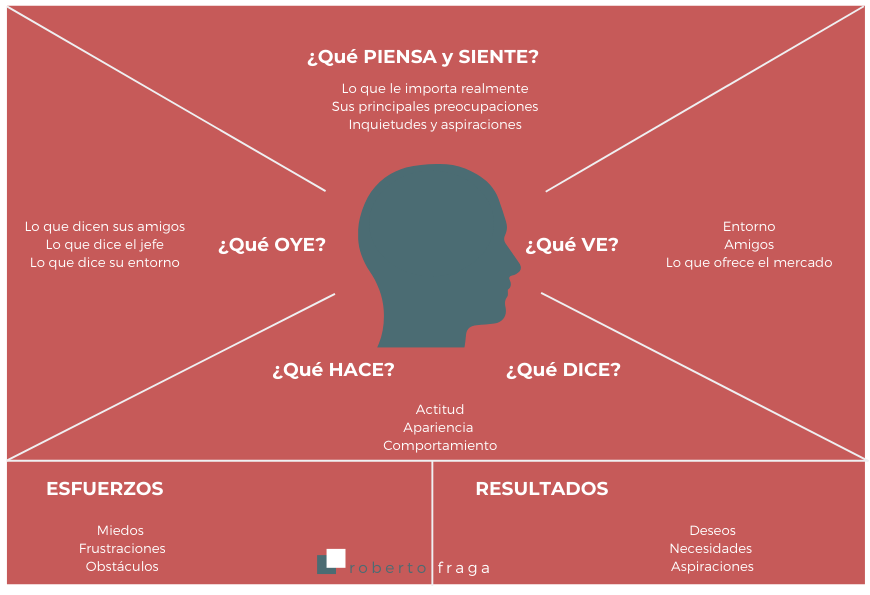
The customer empathy map is divided into six different areas, each of which answers a specific question, as mentioned above. Those questions are the following:

What do they think and feel?
This area refers to the most emotional side of your target customer, so this is where we need to ask deeper questions in order to understand the way they think and try to guess what they feel.
We need to ask ourselves what truly matters to our customer, what their main concerns and worries are, and try to understand what their dreams and aspirations may be. It is also important to figure out what their key motivations are, since all of this will help us define the emotional side of our buyer persona and attempt to address those elements through our product or service.

What do they see?
In this case, we are referring to the area in which we try to put on the glasses through which the customer sees their environment and the world around them—one of the most influential factors in any customer’s behavior.
To do that, we should try to answer questions such as what the world around them looks like, what their friends and family are like, and what they perceive in them. It is also important to investigate what the current market is offering to meet their needs, since that can give us valuable information about our customer.

What do they say and do?
When we talk about what your target customer says and does, we are referring to the more behavioral side of the profile—that is, how they act in their day-to-day life and the attitude they show toward their environment, both personally and professionally.
That is why at this point we need to analyze in depth how they behave, what their attitude is like, and how they speak. We should also look at whether there is a contradiction between what they say and what they do, so that we can identify behavioral strengths and weaknesses that help us complete the most accurate picture possible of this target customer profile.

What do they hear?
Another important factor in empathizing with our customer is understanding what they hear—not only from the people around them, but also from the media and even social networks.
Therefore, in addition to analyzing the environment around them, it is important to understand what message that environment is sending them. We should analyze what their family and friends tell them, what their boss and coworkers tell them, what anyone else in their environment says, and what messages they receive through different communication channels. This will allow us to assess whether the comments and information they receive influence the way they act.

What efforts are they making?
The efforts our customer makes in the way they act and think are closely tied to their fears and frustrations, as well as the barriers and obstacles they encounter in everyday life—sometimes to the point where those things stop them from taking certain actions altogether.
That is why we need to analyze in depth what things make them feel fear or uncertainty, why they have certain barriers, what kinds of obstacles they may have encountered in life, and what challenges or risks they have chosen to take on—or avoid—as a result of those fears. In many cases, those barriers may be connected to the product itself, in areas such as price or ease of use.

What results or benefits do they expect to gain?
When we talk about the results or benefits our customer expects to gain, we are really talking about the desires, needs, or aspirations they want to see fulfilled—the things they need in order to feel truly satisfied.
So once we reach this area, it is time to figure out what their needs are and what their real aspirations are—in other words, clearly identify what they want most and how they measure the level of success they have had in pursuing those goals.
If we are able to answer all of these questions, we will end up with a very complete empathy map of our target customer—but the work is still not finished.
Phase Four: Validate
The final phase of the process is not simply creating the empathy map. We must also carry out qualitative and quantitative research that allows us to validate the hypotheses we have arrived at through the map.
There are different ways to carry out this phase. However, one methodology that works extremely well is to take those assumptions into a real environment where they can be confirmed or disproven—for example, through personal interviews or surveys with people who fit each of the profiles we humanized in phase two.
Empathy Map Example
It is possible that, even after all the recommendations and steps I have just described, you still may not know how to create an empathy map for your specific project. So below, we are going to walk through an example. Ready? Let’s begin!
First, for our fictional example, we will use a project focused on launching a new fitness and nutrition app, with personalized workout plans and customized diet plans for each type of user.
After defining the different customer segments, we are going to focus on one of them: a woman between 30 and 45 years old, living in a large city, earning a middle-income salary, with a stable job, little time for exercise, but concerned about living a healthy life and staying in the best physical shape her lifestyle allows.
This way, we are defining one of the target segments for the project, but the second step is still missing: humanizing a person within that segment, which is also known as an archetype or buyer persona. In this case, we are going to define our buyer persona for the current segment as follows:
Name: María
Age: 35 years old
Job: Finance Director at an SME
Marital status: Single, in a relationship
Estimated salary: €30,000 to €35,000 per year
Location: Madrid
Hobbies: Fashion, reading, music, and movies
Now we are ready to get to work and begin building the empathy map for our buyer persona:
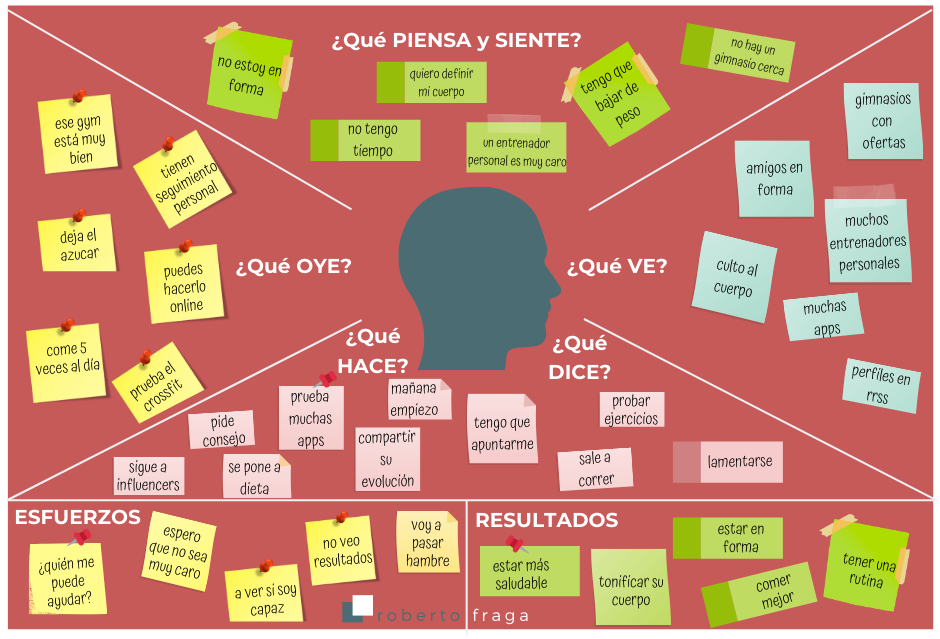
What does María think and feel? María is concerned about her physical condition and believes she should exercise more in order to reach her ideal weight. She would also like to tone her body so she can feel better about herself. However, she faces the problem that there are no sports centers near her home, except for a small gym that is crowded almost all day long, and she is looking for something more personalized, which, on the other hand, is much more expensive.
What does she see? Many of her friends are passionate about fitness and follow very consistent workout routines, whether at the gym or at home. She is constantly exposed to workout apps and fitness influencers through the social network she uses most—Instagram—and she is surrounded by an environment in which physical appearance and fitness are increasingly important.
What does she say and do? María decides to start a routine, but she is not very sure how to go about it. She asks her athletic friends for advice, starts following many of those influencers and online channels that frequently share workout routines, goes running for a couple of days, and shares her progress on social media to motivate herself—but she finds it hard to stay consistent and starts getting frustrated about it.
What does she hear? Through the different parts of her environment, María receives multiple messages. Her boss and coworkers recommend the gym near the office, while her brother suggests trying CrossFit because he thinks she will like it, and recommends a YouTube channel run by a well-known personal trainer she can use to work out from home. At the same time, some of her athletic friends tell her that by maintaining a healthy diet, cutting out sugar, and eating five meals a day to manage her appetite, she will start seeing results much sooner.
What efforts is she making? María’s main problem is that she does not know which direction to take or who to listen to. She believes a personal trainer would be too expensive, and she is not even sure she would be able to get the results she wants. She is also afraid of starting a diet that is so strict it will leave her feeling hungry all the time. All of this causes frustration, and she ends up thinking that this time will be just like the last one—she has started strong, but sooner or later she will quit again.
What results or benefits does she expect to gain? María wants to finally achieve her goals, feel healthier by improving her eating habits, tone her body, and feel fit—while somehow making room in her difficult weekly schedule for a workout routine at least two or three days a week.
By putting ourselves in María’s place, we have tried to identify all the factors that influence the way she thinks and behaves, which is a major advantage when it comes to designing our service proposition for profiles similar to hers. Ideally, as mentioned earlier, we should create as many empathy maps as there are different segments or customer types we have been able to define. That way, our project will place the customer and their needs at the center of our value proposition, minimizing the risk of making mistakes when shaping the product or service that best fits them.
So, do you have a business idea in mind? Try creating an empathy map to define your customer, and I’m sure you’ll come up with an outstanding result.