Types of Funding for Entrepreneurs and Startups
When it comes to launching a new project or building a new startup, entrepreneurs face a number of challenges. Arguably, two of the toughest are validating that the business idea is the right one—that is, confirming that the product or service we plan to launch actually meets the needs of the target audience—and, on the other hand, securing the resources needed to make it happen.
As you may already know from other posts on my blog, there is a methodology called Lean Startup designed to address the first of these challenges. Its goal is to validate your business idea quickly and with the fewest possible resources—not only financial resources, but also human, technological, and others.
However, once a startup has validated its product or service through a compelling enough value proposition to attract an initial group of customers, and through a minimum viable product that helps define the features and attributes of the final product, the need arises to have enough capital to gain traction and start taking the next steps.
In this post, I’m going to walk you through the most common types of funding currently available to entrepreneurs and startups—so take note, because here we go!
Vocabulary Related to Funding Rounds
Before diving into the different funding alternatives for your startup, let me first introduce you to some of the most common concepts used in the investment world, so they feel familiar if you come across them throughout this post—or, more importantly, in your day-to-day life as an entrepreneur:
Investment round: although it is now often associated with an event—either public or private—where different entrepreneurs pitch their projects to potential investors in order to raise money, an investment round actually refers to the process a startup goes through to secure the capital it needs to develop its business model.
Valuation: this is an indicator of your startup’s value at a given point in time. Initially, your startup’s valuation is set by the entrepreneur. In other words, as an entrepreneur, you can argue that your startup is worth one million euros because that is what you expect to generate in revenue within a year. In reality, however, valuation tends to be a kind of middle ground between what you believe your startup is worth and what potential investors believe it is worth. When we talk about valuation, we are usually referring to two different types:
Pre-money valuation: this is the value of your project before receiving the money you are seeking. For example, if you believe your startup is worth €1.5 million and you are seeking €100,000 in investment, your startup has a pre-money valuation of €1.5 million.
Post-money valuation: this is the value of your startup after adding the external funding you are seeking. For example, continuing with the previous scenario, your company would have a post-money valuation of €1.6 million, since the initial €1.5 million valuation is increased by the €100,000 raised in the funding round.
Dilution: this is the percentage of ownership you lose in your company when you complete an investment round and bring in new shareholders. For example, if your company has a pre-money valuation of €1 million and you bring in a partner who invests €100,000, you would have to give that partner a 10% stake in the company. As a result, you would be diluted by 10% and would still retain 90% ownership of your startup.
Due diligence: this is a process of investigation and analysis carried out as part of negotiations between entrepreneur and investor in order to establish a fair value for the startup. Typically, this process is only conducted for larger investment rounds and when the startup is at a more advanced stage, meaning there are already assets and financial results that can be assessed and audited.
Seed: literally meaning “seed” in English, this term refers to a startup at a very early stage that is just beginning to take its first steps.
Growth: this refers to the growth stages of a startup, which are typically associated with greater investment needs.
Exit: congratulations—you’ve sold your startup.
Funding Sources for Entrepreneurs
Now that you are familiar with the main investment-related terms, the first thing you should know is that there are different ways to fund an entrepreneurial project or startup. Without getting too deep into complex classifications, we could group these funding methods into four major categories:
Self-funding: the financial resources the entrepreneur is personally able to contribute in order to develop the project. As a general rule, personal funds are usually limited, which is why entrepreneurs often turn to external funding sources like the ones listed below.
Non-repayable funding: this usually refers to public grants from the national government, regional governments, the European Social Fund, city councils, and so on. It is called non-repayable funding because, unless certain conditions apply, there is no obligation to pay back the amount received.
Repayable funding: this is usually tied to bank loans, participating loans, lines of credit, and similar financial instruments.
Venture capital funding: this is what we commonly think of as investors—individuals or legal entities that invest money in an entrepreneurial project, assuming the risk involved in exchange for shares or equity in the company, and expecting future capital gains that will allow them to recover their investment and make a profit.
The second thing we must keep in mind is that, nowadays, it is no longer necessary to make major financial commitments from the earliest stages. Instead, financial needs should align with the stage the project is currently in, and should therefore increase progressively.
This gives rise to what we might think of as a financial needs cycle, which moves in parallel with the company’s growth cycle. In this process, timing and the amount of funding raised are extremely important, so that you can accurately meet what your project needs at each moment.
First of all, we need to be able to estimate your startup’s present and future needs—at least over the next three to five years. These financial needs should be justified in a carefully developed financial plan and supported by a thorough business plan that, in addition to serving as your introduction to potential investors, demonstrates the technical and economic viability of your project.
Obviously, predicting the future is much more difficult than we tend to imagine. For that reason, your financial projections need to be coherent—not exact or guaranteed—but clearly and directly connected to your business model, your value proposition, the way your project will generate profits, and the amount of money you need to make it grow.
A Startup’s Funding Cycle
Once we have defined our business model and developed a solid financial forecast, the next step is to determine which funding model best fits your startup, depending on the nature of your product or service and your startup’s potential for growth or scalability.
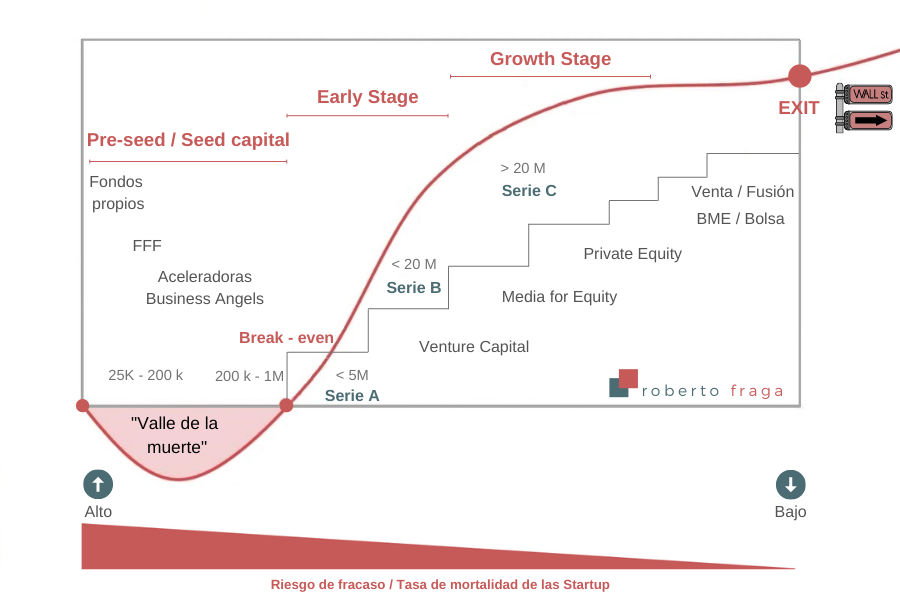
Next, I’ll walk you through the different funding stages a project may go through and the most common funding sources at each stage:
Pre-Seed Capital
This is the stage a project is in during its earliest steps, when the entrepreneur is still defining the business model and everything that entails. At this stage, financial needs are usually not very high. Typically, we just need enough money to dedicate time to the project and begin getting it off the ground—which may sometimes mean giving up a salaried job or covering the costs associated with laying the first foundations of the project.
At this stage, there are many possible funding paths, but perhaps the most important are the following:
Bootstrapping
This term refers to starting an entrepreneurial project with very limited resources, relying only on what the entrepreneur already has available. The term became widely known thanks to major companies like Apple and HP, which started in a garage with very limited financial resources from personal savings. Today, in addition to using existing savings, bootstrapping can also include an entrepreneur doing freelance work for third parties in order to fund their own project.
The advantage of bootstrapping is that it allows you to take the first steps without needing outside funding and to grow organically—that is, at the pace you are able to set for your startup and to the extent that you are able to begin selling your product or service.
Besides HP and Apple, another clear example is GitHub, a company also based in San Francisco, which started in 2007 using its founders’ savings and grew solely through the resources generated by its own sales for four years, until it raised its first funding round of $100 million.
FFF (Friends, Family, and Fools)
In startup jargon, this is known as the “3 Fs.” These three terms refer to friends, family, and “fools”—in other words, people in the entrepreneur’s closest circle who are willing to contribute money, usually in small amounts, so the entrepreneur can move the project forward while taking on all the risks associated with such an early stage, including the high risk of failure and therefore losing everything they contributed without receiving anything in return.
Startup Incubators
A startup incubator is an organization that supports entrepreneurial projects with the potential to enter the market and grow. The capital provided by incubators is usually quite limited, since their main advantage lies in the technical resources and expert mentors they provide to guide startup founders through the process of defining the business model.
Crowdfunding
This is another funding path that has gained traction in recent years. Also known as crowdfunding or collective financing, it involves raising money to fund your project through a collaborative network, while offering something in return, such as company shares or priority access to the product once it is ready to be commercialized.
There are many crowdfunding platforms where you can publish your project in search of funding. Some of the best known are Goteo.org, widely used for projects related to social impact; Verkami, which is strongly oriented toward entrepreneurial projects in the cultural, social, and creative sectors; and Kickstarter, Indiegogo, and Ulule, two of the most recognized platforms worldwide, with millions of funded projects and a wide range of categories in which to publish your project.
Seed Capital
This stage is known as seed capital. At this point, the entrepreneur has already laid the groundwork for the project and is now seeking to bring it to market and begin the validation process with real users, in order to gain traction for the business model and start generating initial revenue from the first customers willing to pay for the product or service.
At this stage as well, there are different funding options for your startup, but the most common sources in a seed round are:
Startup Accelerators
Unlike startup incubators, accelerators come into play when the project is a bit more mature. Their goal is to minimize the risk of failure and bring the product or service to market while reaching the break-even point between revenue and expenses as quickly as possible.
The goal of accelerators is to support the startup not only with capital, but also by providing resources that help it grow quickly and aggressively enough to reach significant revenue volumes. These resources are as varied as they are essential at this stage, since simply providing a free workspace in which to continue developing the project, access to a broad network of contacts, or mentoring from an expert can make a crucial difference in the startup’s success.
Business Angels
These are investors who are usually successful entrepreneurs themselves—or have been in the past—and who have a portion of their wealth set aside to invest in new entrepreneurial ventures. Whether personally or through companies, these investors make an equity investment in the startup in order to provide the financial resources needed to keep developing the product or service and bring it to market with a clearly defined go-to-market plan.
They usually support the entrepreneur with valuable advice drawn from their own experience and help facilitate growth by making their professional network available, but they typically do not get involved in the day-to-day management of the company. The percentage of ownership they take in exchange for the capital they provide depends largely on the valuation assigned to the startup and the amount invested in relation to that valuation.
For example, if your startup is valued at €1 million and a business angel invests €100,000, they would take a 10% ownership stake in the startup.
Equity Crowdfunding
Unlike traditional crowdfunding, equity crowdfunding involves investors with a more professional profile and follows a more structured process, usually carried out through platforms such as The Crowd Angel, now called Dozen, which select projects with the greatest potential and allow investors to buy participation tickets starting at €3,000.
Successful startups such as Glovo, Skitude, and Stayforlong are part of this platform’s portfolio and have raised significant investment through the equity crowdfunding model.
Venture Capital Funds
Venture capital firms or funds typically invest at a more advanced stage of a startup’s life cycle, although some specialize in participating in seed-stage companies. Following a similar approach to business angels, they analyze the startup’s growth potential and invest a certain amount of money based on the company’s valuation in exchange for an ownership stake.
They typically invest based on disruptive technology, a novel market, or the strength of the founding team, among other factors, while accepting a high degree of risk since these startups usually do not yet have a meaningful revenue history, cash flow, or business volume.
Participating Loans
This has become one of the most widely used financing formulas in recent years and has steadily grown into an important funding source for entrepreneurial projects. It is a financial instrument that sits somewhere between equity and a long-term loan.
In other words, these are loans with special characteristics, such as a fixed interest rate plus a variable rate usually linked to the company’s business performance, a long grace period during which no principal is repaid and only interest is paid, or a long-term maturity that allows the startup to finance its growth while repaying the loan in a much more manageable way than would be the case with a traditional loan.
The entity issuing the loan may temporarily become a minority shareholder in the company, or reserve the right to do so for a certain period of time. For example, a startup valued at €1 million may request a participating loan of €100,000 to finance its growth, with a one-year grace period and a five-year maturity with semiannual payments. In that case, starting in year two, it would pay back €12,500 in principal every six months, plus a certain amount of interest.
During that five-year period, the lender may reserve the right to convert the loan amount into equity. In other words, with a €1 million valuation and a €100,000 participating loan, the lender could acquire a 10% stake in the company, thereby releasing the company from the obligation to repay the loan.
In Galicia, there is a publicly backed entity owned in part by the Xunta de Galicia and the Galician Institute for Economic Promotion (IGAPE), which also acts as the manager of several venture capital entities and offers participating loans. It is called Xesgalicia, and on its website you can find very valuable information about the different funding options it offers.
Early Stage
When a startup reaches this stage, it is because it has already validated its business model and is now trying to scale it—whether to lead its target market, expand internationally, enter new markets, and so on.
Funding rounds at this stage are usually classified into what we call series:
Series A: a funding round between €1 million and €5 million
Series B: a funding round between €6 million and €20 million
These rounds are usually led by investment vehicles with strong financial capacity and portfolios that already include established startups, allowing them to continue backing new entrepreneurial projects.
Venture Capital
A venture capital fund usually participates more actively in Series A rounds, in exchange for a minority stake in the company, betting on a project with strong growth potential and seeking to multiply its investment several times over.
These funds invest in high-potential projects while taking on very high risk, given the high failure rate among startups. Not surprisingly, they usually have portfolios with many startup investments across different sectors in an effort to diversify risk—most often in technology-based businesses.
Private Equity
Talking about private equity means talking about investment funds specialized in taking stakes in companies with high growth potential and usually made up of groups of experienced entrepreneurs from different industries.
Unlike venture capital, private equity does not focus exclusively on technology-based companies. It also invests in industrial companies and businesses in other sectors with strong financial returns. Another notable difference compared with venture capital is that private equity usually seeks a stake that gives it control over the company, rather than just a minority ownership position.
Crowdlending
This is a growing trend that, much like crowdfunding, is based on the collaborative economy. In this model, individuals, companies, and even investment funds finance a project in exchange for recovering their investment with interest in the future.
There are currently many crowdlending platforms in sectors such as housing and real estate development. One example is Civislend, a real estate crowdlending platform that allows developers to obtain alternative funding for their projects, repaying principal and interest once the homes have been sold.
Growth Stage
This is the stage of highest growth for a startup, where we move into what we might call Series C—a funding round between €20 million and €250 million—and later rounds. This means the startup has already reached maturity and is preparing to compete more aggressively in the market, grow through new business lines, or even be sold.
In this case, one of the most active funding vehicles is private equity, which was already mentioned in the previous stage, along with large venture capital firms. At this stage, however, it is also common to see the appearance of certain funding methods we have not mentioned yet:
Investment Banks
This is a segment of the banking industry made up of large institutions with enough financial muscle to participate in the intermediation of capital for the sale, merger, or acquisition of companies.
These institutions also specialize in issuing debt securities to be placed on the market. What does that mean? Put simply, when a company issues a bond on the market, it is effectively committing to repay the money lent by the bond purchaser, along with a predetermined interest rate set at the time of issuance, known as the coupon.
Media for Equity
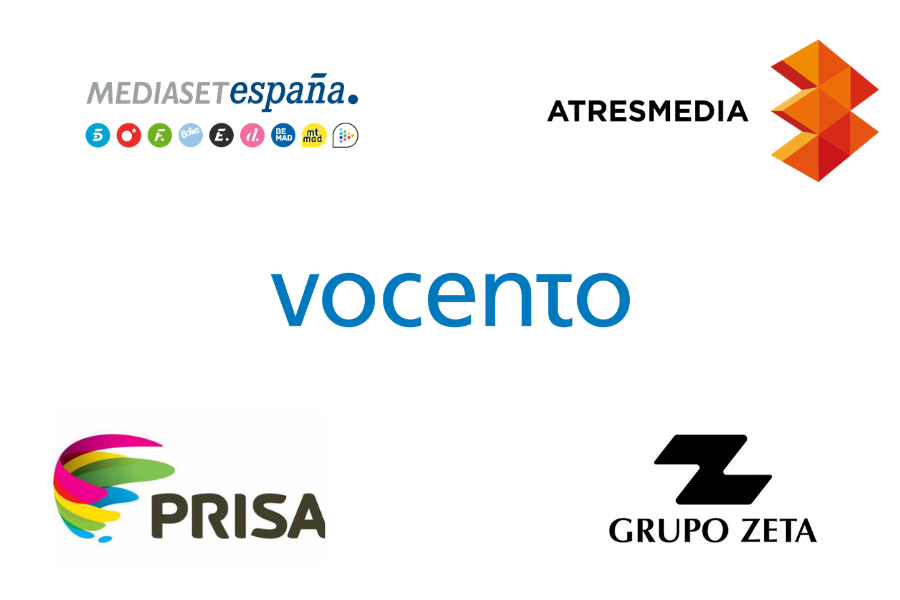
This is an investment mechanism through which a media company acquires an ownership stake in a startup in exchange for advertising. It is one of the formulas often used by major media groups such as Mediaset or Atresmedia, offering startups advertising campaigns across their different channels and platforms in exchange for a percentage of the company.
Keep in mind that a group like Atresmedia has nearly 10 major television channels, such as Antena 3, La Sexta, and Neox, radio stations such as Onda Cero and Europa FM, and countless local media outlets. For a startup in a growth phase, this represents a huge opportunity to gain visibility—something startups like Wallapop and Glovo knew how to leverage in order to accelerate their growth and become startups with multimillion-dollar valuations.
Now do you understand why you see so many TV ads for mobile apps and tech platforms?
Revenue Share
Another way to finance growth during the growth stage is the revenue share model. It basically consists of sharing profits with the platforms that contributed to generating sales.
Sounds odd, right? It can be a bit hard to grasp from the definition alone, but an example makes it much clearer. Imagine you have an online clothing startup and you sign an agreement with a media group like one of the ones we mentioned earlier. Under the agreement, if they advertise your brand on their TV channels, you will give them a percentage of the purchases made on your website or app during the two-hour period following each ad.
Let’s say your website or app is advertised during a commercial break on El Hormiguero, a program with millions of viewers, and thousands of them visit your website after seeing the ad. For the next two hours after the ad airs, you pay Atresmedia a commission on every sale made through your website or app.
Does that mean every single visitor came from the ad they saw during the break? Probably not. But most of them likely did, and that not only helps boost sales but also increases your startup’s visibility and brand recognition. That is why it is such an interesting mechanism. Makes more sense now, right?
Exit Stage
This is the final step in a startup’s life cycle. Once it has matured, achieved exponential growth, and strengthened both its core business model and secondary lines of business that continue to improve scalability, a startup generally faces three main scenarios: continue growing with its own resources, go public on a regulated stock exchange, or become part of a larger company through a merger or acquisition.
One of the biggest deals in recent years was Ticketbis, a Spanish ticketing platform that was sold to eBay for $165 million. In an interview conducted in October 2017, shortly after the sale, its founders said that when they signed the agreement, they only had enough liquidity left to keep the company running for two more weeks.
Another of the most talked-about startup deals in recent years was the acquisition of Slack—one of the most widely used communication and chat platforms in the world—by Salesforce, a multinational company specializing in cloud software and CRM solutions, for more than $27 billion.
In Spain, there is a market that remains unfamiliar to many: BME Growth, formerly known as the Alternative Stock Market (MAB). It is a stock market regulated by Spain’s National Securities Market Commission (CNMV) and managed by Bolsas y Mercados Españoles, the same group that includes the Madrid and Barcelona stock exchanges.
BME Growth is a market designed largely for expanding small and medium-sized businesses, allowing them to attract new shareholders who can fuel growth through capital increases. Unlike Spain’s main stock market, which trades continuously throughout the session from 9:00 a.m. to 5:30 p.m., BME Growth only sets share prices twice a day, at 12:00 p.m. and 4:00 p.m., meaning prices only change twice during each trading session.
It is therefore something like a second division—or perhaps even a third division—where high-potential companies compete to attract financing and eventually become listed on the main stock market.
As you have probably noticed, a startup’s growth and funding cycle is long and requires significant strategic ability to navigate successfully. It is therefore important to internalize that there is a real risk that things may not turn out the way we originally planned—and that does not necessarily mean failure. Rather, we should take valuable lessons from everything learned along the way and, above all, be able to enjoy the process.
Coming soon, I’ll tell you everything you need to know about the different types of public funding available through national, European, and regional grants, as well as highly relevant alternatives offered by organizations such as ENISA, CDTI, or the Official Credit Institute (ICO), all designed for entrepreneurial projects at different stages.