When we are defining our business model, planning a new project, or even preparing to launch a new product or service, it is essential to properly analyze all the internal and external factors that could influence its success or failure.
One of the key tools we should use for this is the SWOT analysis, a tool that, despite being very well known in strategic planning and marketing plan development, is not always used correctly.
That is why in this post I’m going to show you everything you need to know about SWOT, what it is used for, and how you can use it properly for your project—so let’s dive in!
What Is SWOT and What Is It Used For?
A SWOT analysis, also commonly referred to as a SWOT matrix, is a tool that allows us to analyze the current reality of a project, brand, or product from both an internal and external perspective in order to make strategic decisions.

How Do You Do a SWOT Analysis?
To properly carry out a SWOT analysis for our project, we need to keep in mind that SWOT is divided into two different areas of analysis: internal analysis and external analysis. Within the internal analysis, we must clearly identify the strengths and weaknesses of our project or business model, while in the external analysis we will try to identify as specifically as possible the opportunities and threats presented by the environment in which the project is—or will be—developed.
Internal Analysis: Strengths and Weaknesses
When we carry out the internal analysis of our project, we need to identify two key points: first, the strengths that may give us a competitive advantage over others; and second, all the weaknesses that, on the contrary, may place us at a disadvantage when competing in a given market and could be used by our competitors—or even our own customers—to their advantage.
To conduct the internal analysis, it can be very helpful to evaluate, among others, the following factors:
Brand: the size of our brand, as well as awareness and perception of it in the market we are targeting
Marketing: our market share, the reach of our campaigns and promotions, our customer service, our pricing position, and ultimately all factors related to the marketing mix
Organization: the strength and size of our structure, our corporate values, our leadership and management capabilities, our skills, and our know-how
People: the qualifications and distinctiveness of our staff, compensation, loyalty to the company, turnover, experience, and autonomy
Finance: our financial capacity, the company’s debt level, available liquidity, and profitability levels, among other factors
Channels: the strength of our distribution channels or customer relationship channels
Facilities: equipment, the technological and production capacity of our facilities, strategic location, and so on
Assets: all the assets the company has that may represent a competitive advantage over others, such as specialized machinery, innovative technology, and other resources
Barriers to entry: identifying whether our company is positioned in a market segment where there are currently strong barriers to entry for potential new competitors
Patents: any type of patent or intellectual property that may create a competitive difference compared to potential competitors
Strengths
As mentioned above, strengths are the internal factors that can give our project, product, or service a competitive advantage over other players.
Examples of strengths
To help you identify the strengths you may need to define in your project, here are some examples that may be useful:
- We have a major competitive advantage in manufacturing costs
- Extensive experience in business management
- The technology we use has been developed in-house
- We have strong brand recognition
- We have a highly flexible organizational structure
- We hold an exclusive patent
- We have access to external financial resources
- Our company’s geographic location is strategic
- We have an agreement with the leading supplier in the industry
Weaknesses
Unlike strengths, weaknesses create a competitive disadvantage for our company compared to other competitors, which is why it is important to identify these internal factors that limit our chances of success so we can later design an action plan to address them.
Examples of weaknesses
To help you identify the weaknesses you may need to define in your project, here are some examples that may be useful:
- Lack of experience in project management
- No clear business strategy
- High unit costs
- Lack of suitable facilities
- Lower profitability than the market average
- Unfavorable geographic location
- Limited financial resources
- Very limited sales force
- Internal operational and structural problems
External Analysis: Opportunities and Threats
Conducting a proper external analysis of our company will allow us to identify the opportunities we can take advantage of in order to build a competitive edge and grow our business model, while at the same time detecting the external threats that could affect it so we can create a contingency plan if necessary.
There are at least five highly important external factors you should take into account when carrying out the external analysis:
Market: its size, growth or decline trend, and transformation
Customers: changes in demand, behavior, and consumption patterns
Industry: industry trends, types of suppliers and how they are evolving, distribution channels, and key distributors
Competition: market share, size, structure, financial strength, competitive advantages and value proposition, strategy, and positioning
Environment: political, legal, social, economic, and technological factors, among others, that could affect your business in the medium and long term. For this, it is highly recommended to conduct a PESTEL analysis of your business model.
Opportunities
Opportunities are the factors that your company can—and should—take advantage of to its benefit.
Examples of opportunities
Below are some examples of opportunities you may be able to identify in your business, which may help guide your thinking:
- Possibility of expanding the business into new customer segments
- Fast market growth
- International market expansion
- Opportunity to develop new products
- Financial and/or structural problems among key competitors
- Rising customer purchasing power
- Favorable tax policies
Threats
Threats are the external factors that can put your project at risk. Identifying potential threats will allow you to be prepared and have a contingency plan ready to implement if and when they arise.
Examples of threats
Below are some examples of threats that may help you identify the ones that could affect your company:
- New competitors entering the market
- Increased bargaining power of suppliers
- Increased bargaining power of customers
- Unfavorable regulatory changes
- Slow-growing market
- Threat of substitute products
- Political and economic instability
- Rising raw material costs
- Changes in consumer trends
As you can see, properly carrying out a SWOT analysis for your project is very important if we want to have a complete view of all the internal and external factors that affect it—or could affect it. In addition, as mentioned earlier, it allows us to design different strategies that will help us understand how to act based on the information obtained through the SWOT analysis.
Strategy Design
Once the SWOT analysis has been completed, we should begin designing the type of strategy that is most appropriate for our company based on its current situation. To do this, we need to be able to strengthen our strengths, take advantage of the opportunities presented by the environment, and minimize both our internal weaknesses and the potential threats that could put our business at risk.
Depending on the situation we have identified through our SWOT analysis, there are four main strategies we can apply to our business in order to define a clear action plan and a focused roadmap.
Offensive Strategy: Strengths + Opportunities
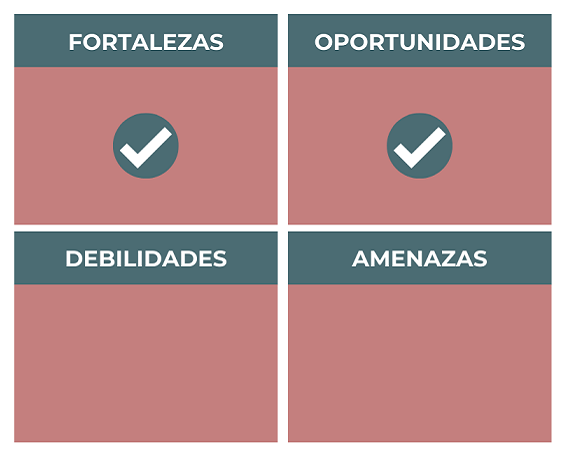
You should choose this strategy if your company is in a privileged position—that is, if you have major internal strengths that give you an important advantage over your competitors, and at the same time the environment in which the company operates presents numerous opportunities that you could take advantage of easily.
In this case, an offensive strategy should lead you to act decisively, seeking growth in market share, profitability, and positioning, while making the necessary investments to consolidate a dominant position based on a strong and confident management model.
Defensive Strategy: Strengths + Threats
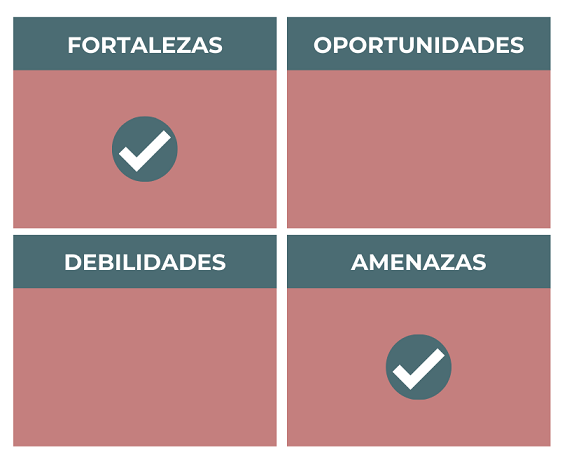
To apply this type of strategy, you should be in an advantageous position in the sense that you have important strengths that provide an edge over the competition, such as a solid structure, strong financial capacity, cost advantages, or robust technological development, among others.
However, the market in which the company operates also presents certain significant threats that could affect it. Therefore, instead of acting as aggressively as in the previous case, the ideal approach is to be somewhat more cautious and make strategic decisions that do not put the company at risk.
Reorientation Strategy: Weaknesses + Opportunities
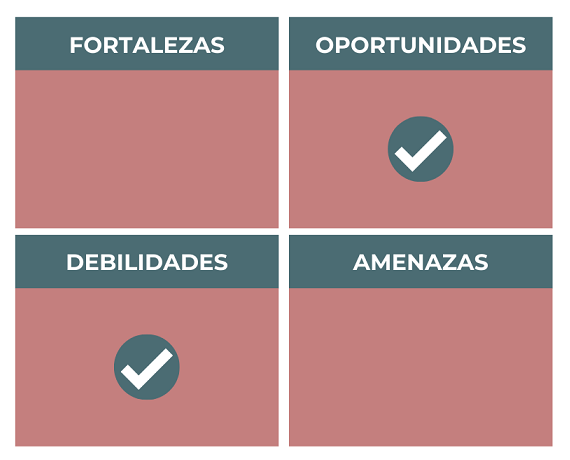
To carry out this type of strategy, we need to be in the opposite situation from the defensive one. In other words, there are a significant number of opportunities in the environment in which the company operates—whether because the market is growing, a major competitor has disappeared, the purchasing power of the customer segment has increased, or due to any other external factor—while internally the company has major weaknesses that make it necessary to reorient its internal strategy in order to correct those weaknesses and shortcomings and take advantage of the market opportunities in order to grow the business.
Survival Strategy: Weaknesses + Threats
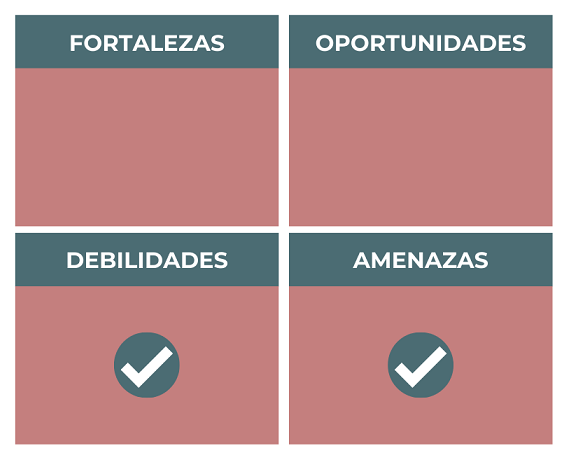
This is the situation that arises when we are in the most unfavorable scenario—the one in which, in addition to the internal weaknesses and shortcomings of our company, the external threats in the environment create an uncertain future.
The strategy here involves working very hard to design actions that will help turn your weaknesses into strengths, while also trying to anticipate and prepare different containment plans to mitigate the possible impact that external threats could have on your company.
Now you know how to do a SWOT analysis, what its purpose is, and what different types of strategies you can adopt depending on your project’s situation. So do not hesitate to use this tool—and to help you with that, I have created a fully editable template that you can download for free from the resources section.