I’m sure you’ve heard about Inbound Marketing many times, along with all the advantages it offers when it comes to attracting potential customers for your product or service.
In this article, you’ll discover what this methodology is all about. It uses little to no intrusive marketing techniques, with the goal of allowing users to discover your brand on their own and recognize all the value you are creating for them. That value is generated mainly through the content your brand creates in order to address the problems and needs of your target customer. In this way, you will be able to attract their attention during the first stage of contact with your brand and then guide them through each of the different stages they go through before making the final purchase.
To do this, it is important to identify each of those stages and create the right type of content for each one, always maintaining a close connection with the user and speaking their language. Only then will you build the trust and credibility needed to make them choose you over another brand.
Interested in learning more about Inbound Marketing?
Then I invite you to read the full article and explore my resources section to take advantage of all the tools that can help you define your own strategy.
What Is Inbound Marketing?
In a complex environment like today’s, where it is becoming increasingly difficult to capture a user’s attention and get them to connect with our brand, there is a growing trend that—although it has been around for many years—is becoming more and more important in any solid marketing strategy: Inbound Marketing.
Inbound strategy, also known as attraction marketing, is about drawing potential customers to our brand by creating content that is useful, relevant, and valuable to the user at the different stages of their journey as a potential buyer of our product or service. In this way, users get to know our company through the touchpoints they receive across different channels such as search engines, the social media platforms where we have a presence, or the content published on our blog.
We need to be clear that this is a medium- to long-term process. While it is true that it will not produce immediate results the way a paid traffic strategy might, it will greatly help us better understand our target user, create valuable content for them, and turn them into a loyal user of our product or service. This leads to more efficient customer acquisition costs and less strain on the sales team, because the user will not buy our product or service because they were pressured into it, but because they perceive value in the content we offer them.
In short, Inbound Marketing is fundamentally about getting the user to find you, instead of you going out to find them.
What Is the Difference Between Inbound Marketing and Traditional Marketing?
If we are talking about traditional marketing, or outbound marketing, we could say that most strategies are focused on advertising campaigns in print or digital media, television, and radio. However, from the user’s point of view, this type of strategy has many shortcomings because, among other things, it is a one-way communication model in which the user has no real interaction with the brand. It also tends to have less impact, because in most cases the message is not delivered at the right time or with the right product for that user’s needs, resulting in lower engagement and even rejection of the brand.
Inbound Marketing, on the other hand, focuses from the start on creating content aimed at solving those needs, making purchase intent the result of the trust and credibility that have been built. User behavior has changed dramatically with digital transformation and the growth of globalization. People behave completely differently than they did ten years ago, which is exactly why a marketing strategy should no longer be built on the same principles it relied on ten years ago.
For this reason, being able to generate attraction among our target customers is becoming increasingly important—bringing them into our strategy and delivering value through high-quality content that makes them feel connected to our brand.
The Inbound Marketing Funnel
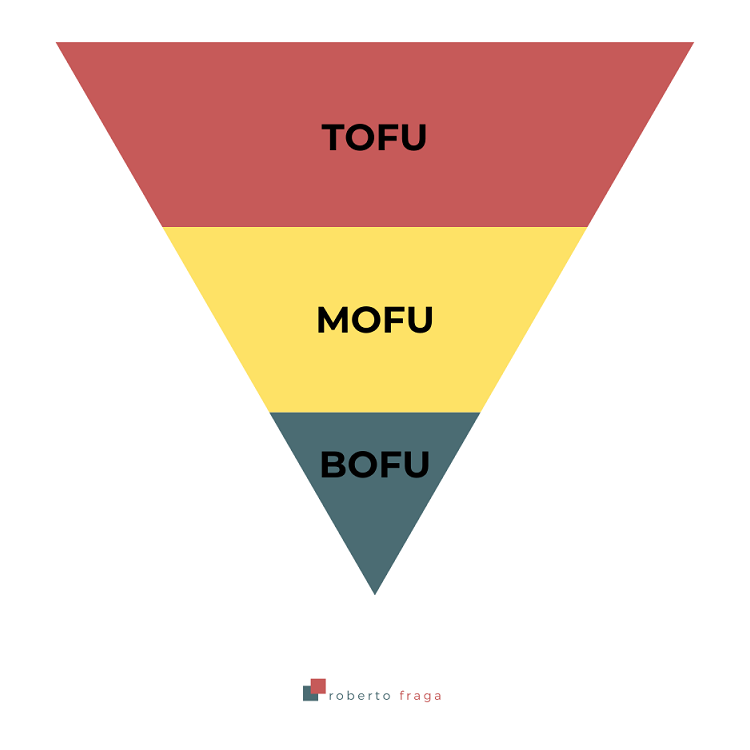
Inbound Marketing is a methodology focused on defining different strategies for each phase of the conversion funnel. In this case, we will talk about the three main phases: TOFU, MOFU, and BOFU, each of which corresponds to the different stages a user goes through when interacting with our brand through digital channels.
TOFU (Top of the Funnel)
The first stage is known as TOFU, since it corresponds to the top of the funnel, where users are looking for a solution to a problem and where our brand should focus on offering valuable information to that potential customer instead of trying to sell them a product. If we try from the beginning to convince a potential customer that they need to buy our product, there is a good chance we are showing them the door and giving up our sales opportunity by causing them to leave our website. However, if we offer them access to valuable free resources such as high-quality blog content, webinars, or short free training sessions, we can create a strong positive first impression.
MOFU (Middle of the Funnel)
At this stage, we need to turn the user into a sales opportunity, or lead. This is one of the most important points in our Inbound Marketing strategy, because our conversion rate from website visitors to leads will determine how effectively we can later carry out actions aimed at different customer segments through remarketing strategies, email marketing, and more.
BOFU (Bottom of the Funnel)
This is the final stage of the conversion funnel, where we pursue the goal of turning a potential customer into an actual customer who buys our product or service. This will largely depend on the work done in the previous stages to attract users who truly have the potential to become customers of our brand, as well as on our ability to convert them, which will depend to a large extent on the effectiveness of our website or sales team, among other factors.
Stages of Inbound Marketing
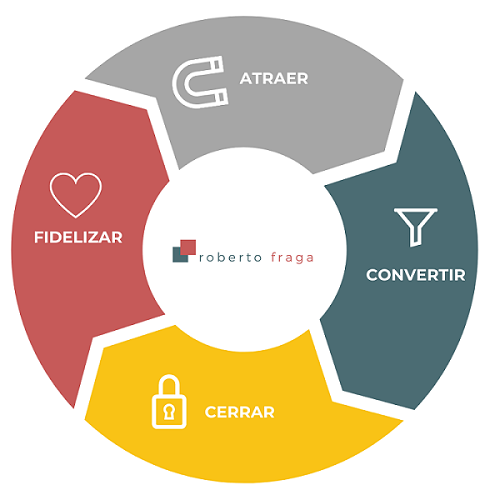
Based on what we just saw in the conversion funnel, we can go a little deeper into the different stages that make up an attraction marketing strategy. It is common to talk about three stages (Attract, Engage, Delight), although in many cases those stages become four, which are the ones we are going to look at below:
Attract
At this stage, we want the user to visit us for the first time, so much of the focus falls on traffic-generation techniques and resources such as SEO, valuable content on social media, paid traffic campaigns in Google Ads, and the various tactics used to bring the user to your website for the first time.
However, there is something important to keep in mind: you are not trying to get just anyone to visit your website, but rather users who are valuable to your business—that is, users who are more likely to convert and therefore increase your chances of making a sale. To achieve this, you need to keep two things in mind:
- Plan a content and acquisition strategy that helps you achieve short-, medium-, and long-term results
- Invest resources in creating high-quality content that is relevant to the user, making sure that content reaches the right user at the right time and through the right channel
Convert
Once we have taken the first step—which, as we have seen, means driving high-quality traffic to our website—we need to use different methods to make sure that as much of that traffic as possible turns into sales opportunities. At this stage, it is essential to have a well-defined lead conversion strategy, using, for example, free resources for the user in exchange for signing up to your database so that you can continue an ongoing conversation with them from that point on.
Close
The third stage of Inbound Marketing is the closing stage, which begins after the previous process in which the user has shared their contact information with us. From that point on, you should begin a more thoughtful approach, offering personalized content based on their tastes and preferences and using every appropriate channel available to connect with each of your potential customers.
To do this, it is important to have a strong implementation of analytics tools that show you how each user behaves when they visit your website repeatedly, when they interact with one of your social media posts, or when they receive one of your emails—so that you know which topics or types of content generate the most interest.
At this stage, it is also important to carry out lead scoring processes, assigning a value to leads based on their estimated quality, as well as lead nurturing, which allows us to enrich the information we have about each lead so we can make it as complete and valuable as possible in the decision-making process.
Delight
Using a CRM (Customer Relationship Management) platform that allows us to properly manage our customer database will help us maintain greater control over each stage of our Inbound strategy, but it carries special weight in the delight phase. This is the stage in which we must retain all the customers who already purchased our product or service in the previous phase through continuous and ongoing contact, continuing to provide them with valuable content, useful information related to their purchase, and all the other resources needed to turn that customer into a promoter of our brand.
In doing so, our acquisition costs go down, because each sale can begin to generate recommendations to third parties from our existing customers.
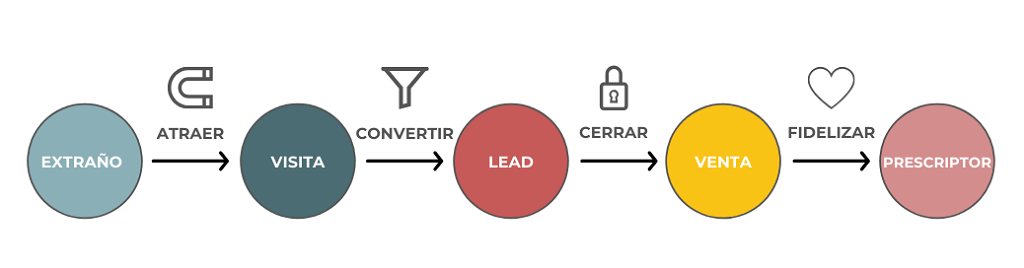
These stages we have just looked at describe the customer lifecycle, also known as the Customer Journey. It is important to provide the right type of content, format, or attention for each of the different stages the user may be in, without forgetting that as they move through the cycle, they will gain more knowledge through the content and resources they have consumed. That means the quality and difficulty of the content, as well as the complexity of the strategy, will evolve in parallel. At the same time, that is a positive sign, because it shows that our strategy has so far been effective in capturing their attention.
As you can see, Inbound Marketing is extremely important for any business when we take into account how users behave today—a behavior shaped by the massive use of digital channels, where feeling trust toward a brand is becoming less and less common. However, with the right strategy, you can achieve great results and make your users recognize all the value you provide through your content, which will undoubtedly improve your business results.