In this post, I’m going to talk to you about the Lean Startup methodology, a method created to develop new business models while minimizing the risk of failure through a system built around shortening the product or service development cycle. In other words, instead of investing too much time in the creation and development of a final product or service, the idea is to gradually launch iterative versions that allow us to validate whether we are really moving in the right direction toward meeting the needs our customer is trying to satisfy. This helps reduce market risk and minimize the investment needed to take the first steps.
The importance of this methodology lies in always putting the customer at the center of the project, because that way the entire development process is built around the customer, and we can validate the different hypotheses we had about their needs directly with them. That allows us to keep moving in the same direction if we were, in fact, on the right track—or, on the other hand, to pivot the project very quickly and without having invested more than necessary, so we can redirect it toward the real needs of our target customer segments.
If you want to learn more about this methodology, enjoy the article!
What Is Lean Startup?
The Lean Startup methodology was originally developed by Steve Blank, a well-known entrepreneur and startup mentor in Silicon Valley, San Francisco, where many of today’s biggest startups were born. Blank worked on developing a methodology that would make it possible to validate products based on customer development, trying to determine through that process whether our product actually meets customer needs and, therefore, whether there is a real chance of success. Later, Eric Ries, a student and disciple of Steve Blank, made the Lean methodology widely known with the release of his book, The Lean Startup, published in 2011, in which he shaped these ideas into a model that can be applied to all kinds of projects.
Until then, there was a standard formula for defining an entrepreneurial initiative: you worked on a business idea, turned that idea into a business plan, looked for the financial resources needed to launch the business and build a team, and then started selling. The problem with that highly linear process was that if one phase failed, it usually brought the others down with it, which resulted in a mortality rate of over 75% for startups that followed it.
Lean Startup is based precisely on the premise that all business ideas, when they are in an early stage, carry a high level of uncertainty that extends from the very definition of the business model to the phase of launching the product or service into the market. It is precisely in this final stage where most projects run into serious problems, because we are starting from the fact that we do not know exactly what our potential customers really want—and in some cases, the uncertainty is even greater, because they may not know either.
For all these reasons, it is necessary to go through a process that allows us to reduce that uncertainty and, therefore, minimize risk. This is achieved through continuous learning, with the goal of adapting our product or service to the market as quickly as possible through a deep understanding of our target customer.
How Do We Apply the Lean Startup Methodology?
In order to apply this methodology to your project, you need to focus your attention on the three main pillars of Lean: build – measure – learn
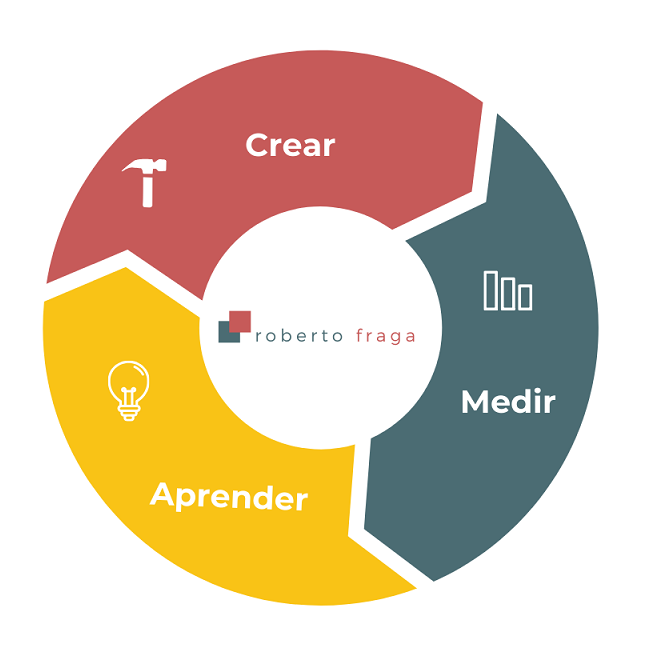
This circular process consists of quickly turning ideas into reality by creating products or services that can be tested in a real market, then measuring and analyzing customer behavior and their reaction to what we are offering them, and finally carrying out a learning and decision-making process through which we must decide whether to continue with the original idea or, on the contrary, whether the market feedback indicates that we need to pivot our business idea.
In this way, this circular approach favors experimentation over planning, because now it is no longer intuition that dominates, but rather the customer’s actual reaction to our product or service. Thanks to this, a new paradigm has been built around one basic principle: “fail fast, fail cheap, and pivot.” This means that if you are able to detect flaws in your business model approach at a very early stage, the financial costs will be dramatically lower, and it will allow you to keep learning continuously by taking those changes back to the market, measuring again, analyzing customer response, drawing new conclusions, and repeating the cycle again and again.
This is not a methodology that replaces the business plan, not at all. It simply reduces the initial phase of any project—even before defining the business plan—to validating that you are working in the right direction, thereby lowering the error rate through the validation of different hypotheses.
What Is a Minimum Viable Product?
This is the point where the concept of the Minimum Viable Product, also known as the MVP, comes into play. This concept refers to a basic version of the product or service idea we want to bring to market, creating a pilot version with just enough essential features to present it to a group of customers who can give us feedback on it.
Thanks to that initial validation, we can gather the first valuable data for our entrepreneurial project, because we will begin to define which improvements and changes need to be addressed first, in order of priority, while also identifying which type of customer responded best to our initial stimuli, thereby becoming our target customer or buyer persona.
What Are the Lean Startup Techniques?
Within the Lean Startup methodology, we can distinguish three techniques that will help us design, define, and validate our business idea.
Customer Development
Customer Development is one of the core elements of the Lean Startup methodology. Also designed by Steve Blank, customer development allows us to research and validate our target customer so that we can build our product or service with the customer in mind and ensure that it solves their needs. In doing so, we build our ideal market, which will be determined by the customer segment we identify, and we ultimately validate the channels needed to reach them in the most effective way.

Business Model Canvas
The Business Model Canvas was created by Alexander Osterwalder in 2009. It allows us to get a global view of all the aspects that directly influence the definition of our business model in a quick and visual way. It is divided into nine blocks, each of which represents a fundamental aspect of the business model. By working through each of these areas, we can begin identifying, defining, and analyzing which hypotheses are the strongest and which are the riskiest, so that we can later test the model in a real environment and start a new validation cycle all over again.
However, the Business Model Canvas is not only useful for startups or projects in the launch phase. It is also an extremely helpful tool for established companies looking to introduce some type of innovation into their products or services, identify new customer segments, add a new layer to their value proposition, or analyze which of their resources are the most critical within their current business model.

Agile Methodologies
Agile methodologies are a set of processes and tools that make it possible to respond much more quickly to the demands a work team may receive from a client at any point during a project’s lifecycle. By applying these methodologies, a company gains a major competitive advantage within its environment, because the product or service delivered to the market will be much more closely aligned with actual demand. In addition, throughout the various stages of the project, we will have different tools to evaluate the team’s performance by setting short review cycles known as sprints, during which the achievement of the objectives set up to that point is evaluated and new goals are established until the date of the next review or sprint.
As we can see, the Lean Startup methodology gives us many tools to save two of the most valuable resources an entrepreneur has when launching a new project—and which are usually limited: time and money.
Ultimately, by following this methodology, we can validate whether our business idea is the right one or, on the contrary, detect the factors we need to change in a very short period of time and at a very low cost. In this way, we can continue refining and building our product or service with a clear focus on the type of user who is actually going to buy or use it. It is also important not to limit the use of these resources to the early startup or launch phase alone. We can—and should—integrate them into the day-to-day operations of the business.
Any time you are able to validate your idea quickly and without significant costs while continuing to define your model, you are accelerating your project.