One of the most fundamental aspects of designing a new business model is defining the value proposition, since the way we create value for our potential users or customers is, in fact, the very heart of the business model.
A value proposition brings together all the emotional and functional benefits that our product or service can offer, and in today’s post I’m going to show you how to properly define your value proposition. On top of that, you’ll also be able to download a fully editable template for free so you can build it by following all the guidelines shown in the example.
What Is a Value Proposition?
A value proposition is the set of benefits that a product or service is able to deliver to a customer in order to meet their needs in a way that is different from how other competitors in the market have been doing it up to that point.
Your value proposition should therefore communicate what you are able to offer better than—or differently from—your competition, turning that into a strategy for each of your customer segments.
How Do You Define a Value Proposition?
To define our value proposition, we need to be able to answer a series of questions:
- Why is a customer going to buy my product or use my service?
- Why won’t they use my competitor’s instead?
- What am I offering that no one else is offering?
- What am I offering that improves on what already exists?
- Does my product or service meet more needs than the options currently available in the market?
Even though these questions may seem very general at first glance, we rarely take the time to go through a thorough reflection process that leads us to the right answers. Only by doing so can we truly define how we are creating real value for our customer.
To help answer many of the questions above—and to understand what else we should ask ourselves in order to clearly define our value proposition—we can try analyzing the following factors:
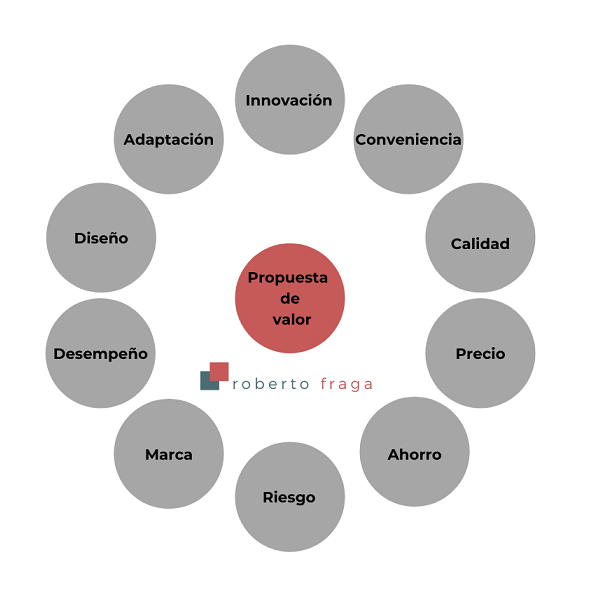
Innovation: my product or service solves customer needs that had not previously been identified.
Convenience: we make life easier for the customer by solving their problem in a different way, saving them time, effort, or money, among other things.
Quality: we deliver a product or service of higher quality than our competitors, whether because of the way it is provided, the materials used, or any other perceived quality factor.
Price: we are able to lower the market price of a product or service while maintaining its value, or we offer greater value in terms of quantity or availability at the current price point.
Savings: we help our customer minimize the cost of using a product or service that meets their need.
Risk: we are able to reduce the risk the customer takes on when purchasing a particular product or service.
Brand: we bring products or services to market that give the buyer a certain social status due to our brand positioning (for established brands).
Performance: we are able to guarantee our customer that the performance offered by our product will be above the usual standard, for example by extending the warranty typically offered in the market.
Design: the design of our product is itself a differentiating factor that will be perceived by the customer as added value, whether because of comfort, aesthetics, or any other design-related factor.
Customization: our product or service is easily adaptable and can be personalized by the customer much more easily than usual.
The Value Proposition Canvas
One of the most widely used tools for helping define the value proposition of a project is the Value Proposition Canvas.

It is a framework that allows us to visually structure, through a graphic representation, the different factors that influence how a customer perceives the value a product or service can offer.
It is divided into two different segments: the customer segment and the value proposition. The right side, where we represent the customer segment, is made up of three distinct sections (gains, pains, and customer jobs) that help us better understand our target audience through an analysis focused on:
- Customer gains: here we should describe the specific benefits our customers would like to get from our product or service.
- Customer pains: in this case, we should identify the obstacles, risks, and bad experiences the customer perceives in relation to their expectations.
- Customer jobs: in reality, this area could be defined as the customer’s expectations when purchasing a given product or service.
This segment represents customer understanding, so it would be very helpful to have previously completed a customer empathy map, in order to gain a deeper understanding of each of our target segments before formulating the value proposition.

The other segment is what is known as the value proposition segment itself, since it describes how our business model creates value for the customer based on the factors we were able to define earlier in the customer understanding segment. Value creation is also made up of three areas:
- Gain creators: we should concisely describe how our value proposition creates benefits for customers.
- Pain relievers: in this case, we describe how our proposition eases the frustrations expressed by the customer segment.
- Products and services: these are the products or services that respond to customer needs and make up our value proposition.
How Do You Create the Value Proposition Canvas?
To properly develop the Value Proposition Canvas, we need to do something very important: put the customer at the center of our thinking, because they are ultimately the one our business model is aimed at.
When evaluating the customer, we need to focus equally on the functional and emotional sides, since both define behavior and can sometimes make that behavior seem irrational.
It is usually easier to identify the problems customers perceive around a product or service, so the customer pains area is a good place to start. Once those obstacles have been identified, you can build on them by defining the benefits the customer expects in the gains area. Finally, you only need to develop the customer jobs, or in other words, their expectations and desired outcomes.
Once you have completed the customer segment, it becomes much easier to work on your value proposition, because just as with gains and pains, the areas related to gain creators and pain relievers go hand in hand.
Example: Value Proposition Canvas
In the following example, it becomes very easy to see how we can work on our value proposition using this tool. It is an example based on the company Spotify and the way it delivers value to users through its business model: a music streaming platform with a freemium model.

Never forget that your value proposition must be perfectly aligned with meeting the needs of your customers or users, which means both segments must be in balance. If they are not, keep working on it until you achieve that balance.
After that, you will only have one final step left: validate your value proposition. And there is only one way to do that—get out of the office, take an MVP (Minimum Viable Product) to market, and start quickly analyzing the reaction of each customer segment. Then, based on those results, continue working consistently to improve your product or service and the way it delivers value to the user through it.